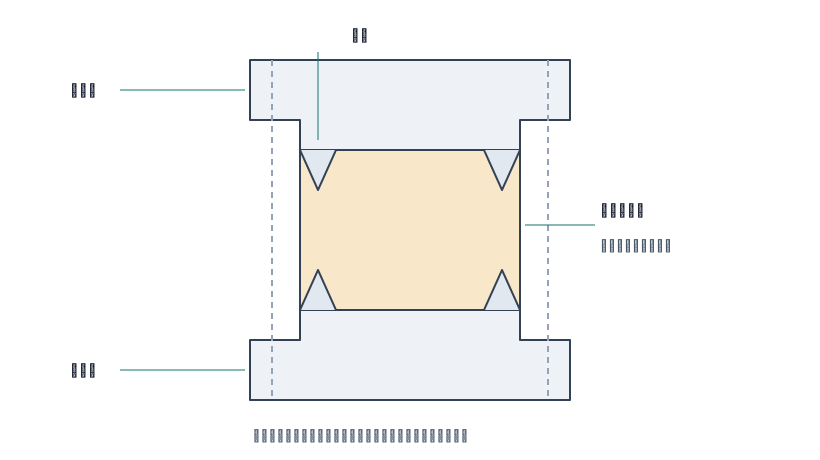
CF (ConFlat, the bakeable flange family around ISO 3669) uses no O-ring: two knife edges press an OFHC copper gasket into plastic deformation to create a metal seal. Edge geometry and surface condition determine ultimate vacuum and leak rate, so it must be machined as a sealing face, not as a profile.
1. Three things to control on the edge
- Face flatness — the face carrying the knife edge must be flat, or the gasket is loaded unevenly and cannot seat.
- Edge angle and height — per drawing or the applicable flange standard; where the drawing is silent, verify against a mating standard part rather than estimating.
- Edge integrity — no burrs, chipping, knocks or scratches. Any notch is a leak path.
2. Machining sequence
- Turn the end face and bore, leaving 0.3–0.5 mm for finishing, and let roughing stress release first.
- Finish-turn the knife-edge face for flatness, then the edge angle with a light final pass to avoid deflection.
- Lightly dress the edge with a stone or lapping compound — remove burrs without rounding the edge.
- Clean, degrease and dry, then protect immediately and move to packing.
3. Build edge protection into the process
- After machining, store edges facing up and never in direct contact with other metal parts.
- Fit protective rings or soft pads at packing; no load on the edge in transit.
- Inspect edges before assembly — do not "grind it a bit and use it anyway": once rounded, the edge can no longer indent the gasket.
4. Common failure causes
- Burrs on the edge — shows as a slow, rising leak rate, easily misdiagnosed as a chamber leak.
- Out-of-flat face — the gasket is pressed over part of the circumference only, and re-tightening will not fix it.
- Reused gaskets — CF gaskets are single-use; a second compression no longer matches the indent.
- Uneven torque — tighten diagonally in stages; a single pass warps the flange.
One rule: CF sealing capability is set by the knife edge. Protect it as the final sealing face from the machining stage — far cheaper than reworking after assembly.